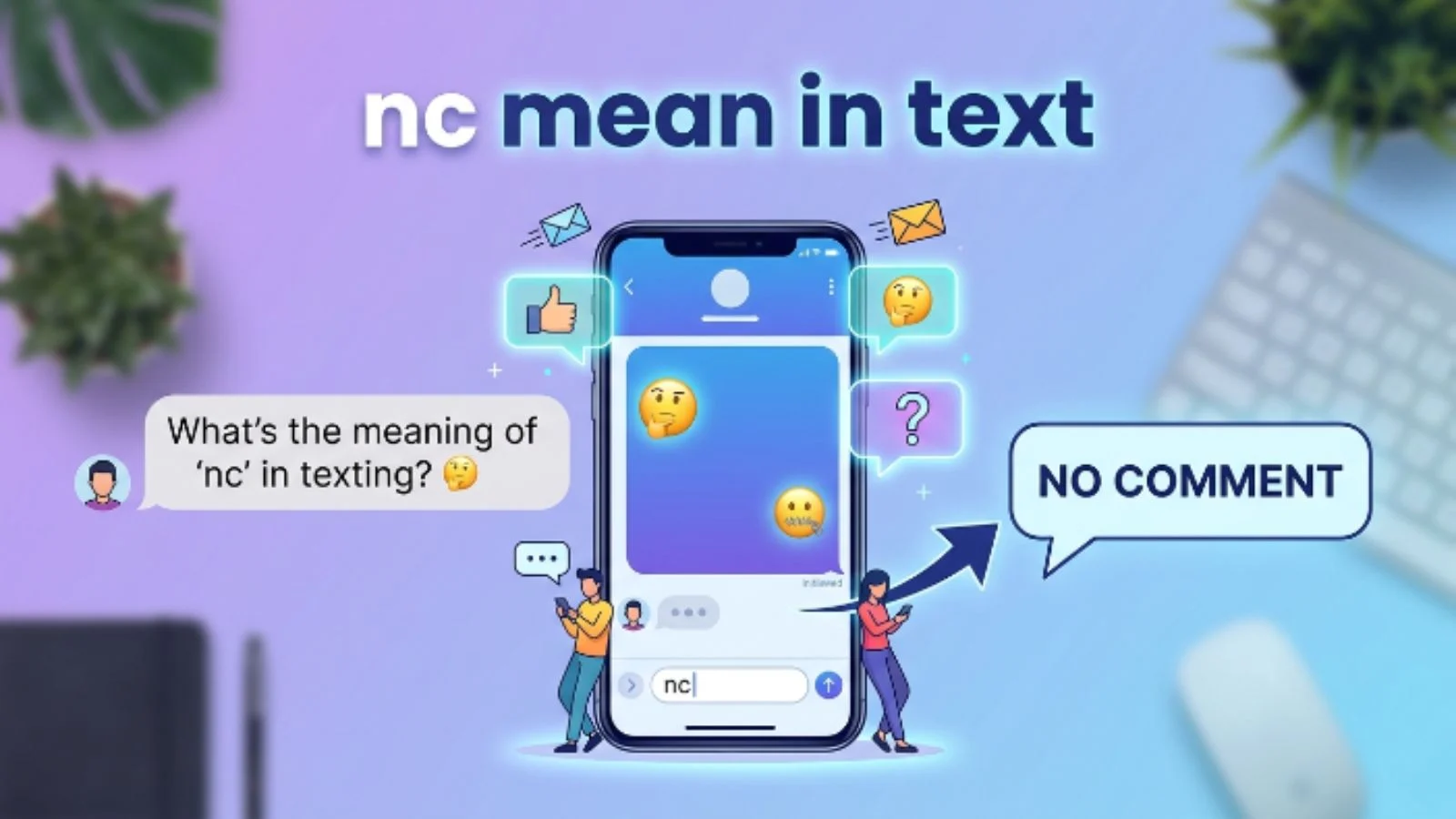
If you have received a message containing “NC” and wondered what it means, you are not alone.
In texting and online communication, NC most commonly means “No Comment.”
People use it when they do not want to answer a question, share their opinion, or reveal information about a topic.
Simple Definition
NC = No Comment
It is a short way of saying:
- I don’t want to answer.
- I have nothing to say about that.
- I prefer not to discuss it.
- I am staying neutral.
Quick Example
Friend: Did you tell everyone about the surprise?
You: NC.
Meaning: You are choosing not to answer the question.
Because texting is fast, many people use abbreviations like NC to save time and avoid typing full sentences.
Why Do People Use NC in Text Messages?
People use NC for different reasons.
Some common reasons include:
- Protecting privacy
- Avoiding arguments
- Keeping secrets
- Staying neutral
- Avoiding awkward conversations
- Being playful or mysterious
In many situations, NC is a polite way to avoid giving information without completely ignoring the message.
Main Meaning of NC in Text
NC = No Comment
This is the most common meaning across:
- Text messages
- Snapchat
- TikTok
- Discord
- Online forums
Example
Sarah: Who do you like?
Jake: NC.
Explanation
Jake does not want to reveal the person he likes, so he responds with “No Comment.”
Other Meanings of NC in Text
Although “No Comment” is the most popular meaning, NC can have other meanings depending on the conversation.
Possible Meanings of NC
| NC Meaning | Usage Context |
|---|---|
| No Comment | Texting and social media |
| No Charge | Business and customer service |
| Not Confirmed | Events and scheduling |
| North Carolina | Location discussions |
| Non-Combat | Military discussions |
| Network Connection | Technology conversations |
| New Character | Gaming communities |
The context usually tells you which meaning is intended.
NC Meaning on Social Media
On social media platforms, NC almost always means No Comment.
People use it when:
- Avoiding gossip
- Refusing to answer personal questions
- Keeping information private
- Avoiding controversy
Example
Comment: Is that your new boyfriend?
Reply: NC.
Explanation
The person chooses not to answer publicly.
NC Meaning on Snapchat
Snapchat users often use NC when they want to keep something secret.
Example
Friend: Where are you right now?
You: NC.
Explanation
You do not want to reveal your location.
Because Snapchat conversations are casual and quick, abbreviations like NC are common.
NC Meaning on Instagram
Instagram users may use NC in:
- Comments
- Direct messages
- Stories
- Q&A sessions
Example
Follower: Are you dating someone?
Creator: NC.
Explanation
The creator is protecting their private life.
NC Meaning on TikTok
TikTok creators often receive personal questions.
Instead of writing a long explanation, they may simply respond with NC.
Example
Comment: Did that rumor happen?
Creator: NC.
Explanation
The creator chooses not to discuss the rumor.
NC Meaning in Online Gaming
In gaming communities, NC can sometimes mean something different.
New Character
Some players use NC to mean New Character.
Example
Player 1: Why is your level low?
Player 2: NC.
Explanation
The player is using a newly created character.
However, this meaning is less common than “No Comment.”
NC Meaning in Business Communication
In professional settings, NC may mean No Charge.
Example
Customer: How much is the repair?
Company: NC.
Explanation
The repair is free and there is no charge.
Business meanings are usually understood through context.
NC Meaning in Scheduling
Sometimes NC means Not Confirmed.
Example
Employee: Is tomorrow’s meeting final?
Manager: NC.
Explanation
The meeting has not yet been confirmed.
Origin and History of NC
The abbreviation NC comes from the phrase “No Comment.”
The phrase has existed for many decades.
Before the internet, journalists often heard celebrities, politicians, and public figures say:
“No comment.”
They used this response when they did not want to answer questions.
As texting became popular in the late 1990s and early 2000s, people began shortening phrases into abbreviations.
Examples include:
- LOL
- BRB
- IDK
- IMO
- NC
Over time, NC became a quick digital version of “No Comment.”
Today, it remains widely used across social media and messaging apps.
How NC Is Used in Everyday Conversations
Example 1
Alex: Did you eat the last cookie?
Emma: NC.
Explanation
Emma does not want to admit or deny it.
Example 2
Ryan: Who won the competition?
Jake: NC.
Explanation
Jake may know the answer but does not want to reveal it.
Example 3
Friend: What did you buy me for my birthday?
You: NC.
Explanation
You are keeping the gift a surprise.
Example 4
Sibling: Did Mom say yes?
You: NC.
Explanation
You are choosing not to share the information.
Example 5
Friend: Are you dating someone?
You: NC.
Explanation
You want to keep your personal life private.
Personality Traits Associated With Using NC
People who use NC frequently may show certain communication styles.
Private
They like keeping personal information to themselves.
Careful
They think before sharing details.
Reserved
They do not always reveal their opinions.
Mysterious
Sometimes they enjoy creating curiosity.
Neutral
They avoid taking sides in arguments.
Remember, using NC does not automatically define someone’s personality. It simply reflects their communication choice in a specific situation.
When You Should Use NC
NC can be useful in many situations.
Protecting Personal Information
Avoid sharing private details.
Keeping Surprises Secret
Hide birthday gifts or special plans.
Avoiding Drama
Stay out of arguments and gossip.
Maintaining Professionalism
Avoid discussing sensitive topics.
Respecting Confidentiality
Protect information that should remain private.
When You Should Not Use NC
Although NC is useful, it is not always the best response.
Serious Conversations
Important discussions deserve clear communication.
Work Responsibilities
Avoid NC when your answer is required.
Customer Service Situations
Customers usually expect detailed responses.
Family Emergencies
Clear communication is more helpful.
NC vs Other Similar Text Abbreviations
Many people confuse NC with other texting terms.
NC vs IDK
| NC | IDK |
|---|---|
| No Comment | I Don’t Know |
| Refuses to answer | Does not know answer |
Example
Question: Who broke the vase?
NC: I won’t tell.
IDK: I don’t know.
NC vs NVM
| NC | NVM |
|---|---|
| No Comment | Never Mind |
| Avoids answer | Drops topic |
Example
Question: What happened?
NC: I won’t say.
NVM: Forget it.
NC vs IMO
| NC | IMO |
|---|---|
| No Comment | In My Opinion |
| Avoids opinion | Gives opinion |
Example
Question: What do you think?
NC: No answer.
IMO: Here’s my opinion.
Common Misconceptions About NC
Many people misunderstand NC.
Misconception 1: NC Always Means Rudeness
Not true.
Many people use NC politely to maintain privacy.
Misconception 2: NC Means Ignoring Someone
Not necessarily.
The person is responding, but choosing not to provide information.
Misconception 3: NC Has Only One Meaning
False.
NC can mean:
- No Comment
- No Charge
- Not Confirmed
- North Carolina
- New Character
Context matters.
Misconception 4: NC Is Outdated
Incorrect.
NC remains widely used on social media and messaging apps in 2026.
Modern Examples of NC in 2026
The way people communicate continues to evolve, but NC remains relevant.
Example in Group Chats
Friend: Who leaked the screenshots?
User: NC.
Explanation
The user does not want to reveal information.
Example in TikTok Comments
Follower: Are you quitting social media?
Creator: NC.
Explanation
The creator is not ready to discuss future plans.
Example in Gaming
Player: What’s your secret strategy?
Player 2: NC.
Explanation
The player wants to keep their strategy private.
Example in Streaming Communities
Viewer: What project are you working on?
Streamer: NC for now.
Explanation
The streamer plans to reveal it later.
Example in School Chats
Student: Did we pass the exam?
Friend: NC.
Explanation
The friend knows the result but wants the teacher to announce it.
How to Respond When Someone Says NC
If someone replies with NC, avoid pushing them for information.
Good responses include:
- “Okay, no problem.”
- “I understand.”
- “Maybe later.”
- “Fair enough.”
- “Your secret is safe.”
Respecting boundaries helps maintain healthy communication.
Signs That NC Means “No Comment”
You can usually identify the meaning through context.
NC probably means “No Comment” when:
- Someone asks a personal question.
- A secret is involved.
- The topic is sensitive.
- The person seems playful or mysterious.
- The conversation is casual.
Example
Friend: Who told you that?
You: NC.
Since a personal question was asked, “No Comment” is the likely meaning.
Frequently Asked Questions
Is NC a bad response in text?
No. NC is usually a neutral response. It simply means the person does not want to answer a question.
What does NC stand for in texting?
The most common meaning is No Comment. It is used when someone prefers not to share information.
Is NC rude?
Not usually. Tone and context matter. Most people use NC politely to protect privacy or avoid conflict.
What does NC mean on Snapchat?
On Snapchat, NC generally means No Comment and is used to avoid answering a question.
What does NC mean on Instagram?
On Instagram, NC usually means No Comment, especially in comments, stories, and direct messages.
Can NC mean something other than No Comment?
Yes. Depending on the context, it can mean No Charge, Not Confirmed, North Carolina, or New Character.
Is NC still used in 2026?
Yes. NC remains a popular abbreviation across texting apps, social media platforms, gaming communities, and online conversations.
Conclusion
Understanding NC mean in text is simple once you know the context. In most conversations, NC stands for “No Comment,” a short and convenient way to avoid answering a question, protect privacy, or keep information secret. While NC can also mean No Charge, Not Confirmed, North Carolina, or New Character, the surrounding conversation usually makes the meaning clear. As texting and social media continue to evolve in 2026, NC remains a useful and widely recognized abbreviation. The next time you see NC in a message, you’ll be able to understand exactly what the sender means and respond appropriately.