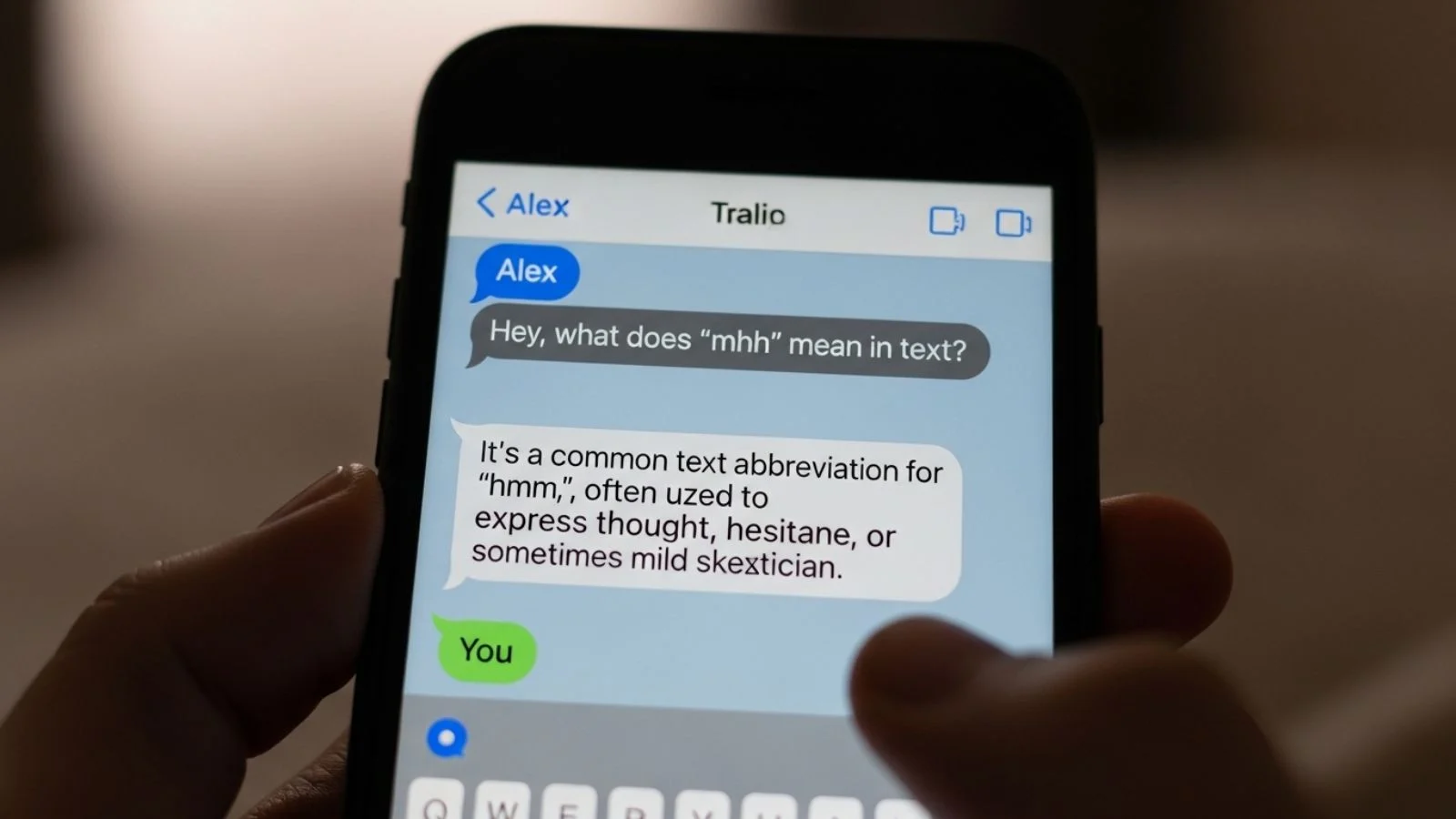
In texting and online conversations, MHH is a short form used to express thinking, hesitation, doubt, or mild disapproval. It is not an acronym with a fixed expansion but more of a sound people type to show they are pondering or unsure.
For example, if someone asks, “Do you like pineapple on pizza?” you might reply, “MHH, not really my favorite.” This indicates hesitation or a mild negative reaction.
Origin and History of MHH
MHH emerged from online texting culture in the early 2010s, alongside other expressions like “hmm” or “meh.” Unlike formal abbreviations such as LOL (Laugh Out Loud) or BRB (Be Right Back), MHH is an onomatopoeic expression—it represents a sound we make when thinking or hesitating.
Over time, MHH became popular on platforms like WhatsApp, Instagram, Facebook Messenger, and texting apps, particularly among teens and young adults. Its use is informal and conversational.
How to Use MHH in Texting
Using MHH correctly depends on tone and context. Here are some common scenarios:
Expressing Doubt or Uncertainty
- Example Dialogue:
- Person A: “Should we try the new cafe today?”
- Person B: “MHH, I heard the food is expensive.”
- Explanation: Person B is unsure about visiting the cafe.
Showing Mild Disapproval or Disagreement
- Example Dialogue:
- Person A: “I love wearing socks with sandals.”
- Person B: “MHH, that’s a strange choice.”
- Explanation: Person B is politely expressing disagreement.
Thinking or Pausing Before Answering
- Example Dialogue:
- Person A: “What do you think about the movie?”
- Person B: “MHH, it was okay but not great.”
- Explanation: Person B uses MHH to indicate reflection before giving an opinion.
Personality Traits Associated with MHH Users
People who frequently use MHH in texts often have certain communication traits:
- Thoughtful: They think before replying.
- Casual: They prefer informal, conversational tone.
- Cautious: They may avoid strong opinions.
- Polite: They use MHH to soften disagreement.
Common Mistakes or Misconceptions
While MHH is simple, beginners often make these mistakes:
| Mistake | Correct Usage | Explanation |
|---|---|---|
| Using MHH as a formal abbreviation | MHH should only be informal | MHH is conversational, not professional. |
| Confusing MHH with “MMH” or “HMM” | Stick with MHH for hesitation or doubt | HMM is also a thinking sound, but MHH has a slightly milder tone. |
| Overusing MHH | Limit to one per response | Overuse can make texts sound indecisive or boring. |
Modern and Relatable Examples (Updated for 2026)
- Example 1:
- Friend 1: “Do you want to invest in this crypto?”
- Friend 2: “MHH, I need to research more.”
- Explanation: Shows caution in financial decisions.
- Example 2:
- Teen 1: “I’m thinking about dyeing my hair neon green.”
- Teen 2: “MHH, that’s bold but could be fun.”
- Explanation: Expresses hesitation and mild curiosity.
- Example 3:
- Colleague 1: “We should send the report by today.”
- Colleague 2: “MHH, I think we need more data.”
- Explanation: Politely suggests a different approach.
Tips for Using MHH Effectively
- Keep it short: Usually one MHH per response.
- Use with context: Add a phrase to clarify your thought.
- Avoid in formal texts: Emails, work reports, or official communication.
- Combine with tone indicators if needed: Like “MHH, not sure :/” for extra clarity.
Real-Life Dialogues Using MHH
- Casual Chat:
- A: “Do you want to go hiking tomorrow?”
- B: “MHH, maybe if the weather is nice.”
- Explanation: Shows tentative agreement.
- Social Media Comment:
- Comment: “MHH, not sure about this outfit.”
- Explanation: Indicates mild disapproval without rudeness.
- Group Chat:
- Friend 1: “Should we order pizza or sushi?”
- Friend 2: “MHH, pizza sounds safer.”
- Explanation: Suggests preference after thinking.
Variations and Related Expressions
- HMM: Stronger thinking sound.
- MMH: Often used to show agreement with hesitation.
- MEH: Shows indifference rather than thought.
Frequently Asked Questions
1. What does MHH stand for?
- MHH is not an acronym. It represents a thinking or hesitation sound in text.
2. Is MHH formal or informal?
- MHH is strictly informal and should only be used in casual chats or social media.
3. Can I use MHH in professional emails?
- No. MHH is conversational and not appropriate for professional communication.
4. How is MHH different from HMM or MEH?
- HMM: Stronger thinking or curiosity.
- MEH: Indifference or lack of interest.
- MHH: Gentle hesitation, doubt, or mild disapproval.
5. Can MHH be used sarcastically?
- Yes. Depending on context and tone, MHH can express sarcastic hesitation.
6. Is MHH popular in 2026?
- Yes. It remains common in texting and social media, especially among young adults.
7. How do I pronounce MHH when speaking?
- Pronounce it like “mm-hh,” similar to a soft hum while thinking.
Conclusion
In 2026, MHH continues to be a versatile and informal way to express thought, hesitation, or mild disagreement in texts. Understanding its context and tone is essential to communicate clearly without sounding rude or indecisive. Remember to use MHH sparingly, pair it with clarifying phrases, and avoid formal settings. By incorporating MHH thoughtfully, your digital conversations can feel more natural and relatable. Explore more texting shorthand to stay up-to-date with evolving online communication trends.