You’ve probably seen someone write “AF” at the end of a sentence and wondered what it really means.
Maybe a friend texted, “I’m tired AF,” or you noticed it in a comment online.
It looks simple, but it carries strong emotion. People use it to express feelings more intensely without writing a long explanation.
Understanding “AF” helps you read modern conversations correctly and avoid awkward misunderstandings. Once you know it, you’ll start noticing it everywhere.
AF Mean in Text – Quick Meaning
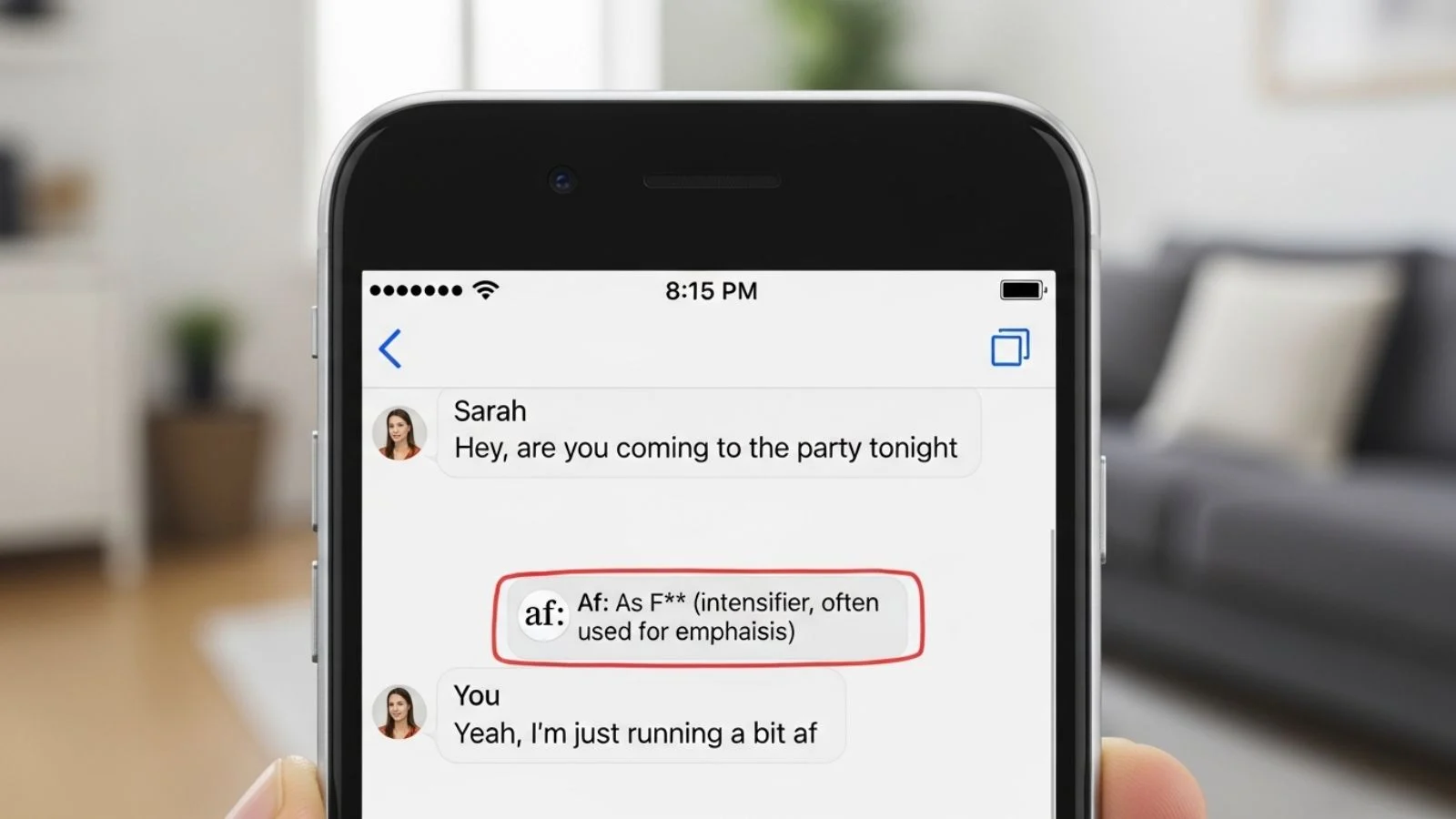
AF in text means: “As f*.”**
It is used to add strong emphasis to a feeling, situation, or description.
It usually means:
- Very
- Extremely
- Seriously
- Intensely
People use it to strengthen what they’re saying.
Examples:
- “I’m hungry AF.”
- “This movie is boring AF.”
- “She looks happy AF today.”
In simple words, AF makes emotions stronger.
Origin & Background of AF
The term “AF” comes from the phrase “as f*,”** which has been used in spoken English for decades.
Originally, people said things like:
- “Cold as f***”
- “Funny as f***”
But when texting and social media became popular, people shortened it to AF.
Typing the full phrase felt too long or too harsh, so AF became a cleaner, quicker version.
Its popularity grew rapidly with platforms like:
- TikTok
Today, AF is part of everyday digital language, especially among younger generations.
Real-Life Conversations Using AF
Here are real, natural conversations based on how people actually use it.
WhatsApp Conversation
Person A: I didn’t sleep last night.
Person B: Same. I’m tired AF at work.
Person A: Coffee helps?
Person B: Only a little.
Instagram DM Conversation
Person A: Your vacation pictures look amazing.
Person B: Thank you. I was happy AF there.
Person A: I can tell.
TikTok Comments Conversation
Person A: This song is emotional AF.
Person B: Yes, it reminds me of my past.
Person A: Same here.
Text Message Conversation
Person A: Are you nervous about the interview?
Person B: Yes, nervous AF honestly.
Person A: You’ll do great.
These examples show that AF adds emotional intensity.
Emotional & Psychological Meaning
AF is not just slang. It reflects how people feel inside.
People use AF when emotions are:
- Strong
- Honest
- Raw
- Immediate
Instead of saying:
“I am very excited.”
They say:
“I’m excited AF.”
It feels more real and personal.
It also shows comfort and openness. People usually use AF with friends, not strangers.
It reflects modern communication, which is:
- Faster
- More emotional
- Less formal
AF helps people express feelings quickly.
Usage in Different Contexts
Social Media
AF is extremely common on social media.
Examples:
- “This food is good AF.”
- “Life is stressful AF.”
It makes posts feel relatable.
Friends & Relationships
Friends use AF comfortably.
Examples:
- “I miss you AF.”
- “You’re funny AF.”
It shows closeness.
In romantic relationships, it can show affection:
- “I love you AF.”
Work or Professional Settings
AF is usually not appropriate in professional settings.
Avoid saying:
- “I’m busy AF”
Instead say:
- “I’m very busy.”
AF can sound unprofessional.
Casual vs Serious Tone
Casual tone:
“I’m bored AF.”
Serious tone:
“I’m concerned AF.”
The meaning stays the same, but emotion changes.
Common Misunderstandings
Many people misunderstand AF.
Misunderstanding 1: Thinking it’s polite
It’s not always polite.
It contains hidden strong language.
Avoid using it with:
- Bosses
- Teachers
- Formal communication
Misunderstanding 2: Thinking it means something else
AF does not mean:
- Always forever
- Adult friend
Its main meaning is emphasis.
Misunderstanding 3: Using it too often
Overusing AF makes communication look immature.
Use it naturally.
Misunderstanding 4: Using it with strangers
It can feel too personal.
Comparison Table: AF vs Similar Slang
| Term | Meaning | Strength Level | Professional Use |
|---|---|---|---|
| AF | Extremely | Very strong | No |
| Very | Extremely | Medium | Yes |
| Super | Very | Medium | Sometimes |
| So | Very | Medium | Yes |
| Extremely | Very | Formal strong | Yes |
| Really | Very | Medium | Yes |
| Kinda | Slightly | Weak | Yes |
| Barely | Almost not | Opposite | Yes |
Key Insight:
AF is stronger emotionally but less professional than traditional words.
Variations of AF (Common Types)
Here are popular variations people use.
1. Funny AF
Means extremely funny.
Example: That video is funny AF.
2. Tired AF
Means extremely tired.
Example: I’m tired AF after work.
3. Happy AF
Means extremely happy.
Example: She looks happy AF today.
4. Sad AF
Means extremely sad.
Example: That scene was sad AF.
5. Cute AF
Means extremely cute.
Example: That baby is cute AF.
6. Bored AF
Means extremely bored.
Example: I’m bored AF at home.
7. Hungry AF
Means extremely hungry.
Example: I’m hungry AF right now.
8. Nervous AF
Means extremely nervous.
Example: He’s nervous AF before exam.
9. Busy AF
Means extremely busy.
Example: I’m busy AF this week.
10. Cold AF
Means extremely cold.
Example: It’s cold AF outside.
How to Respond When Someone Uses AF
Your reply depends on your personality.
Casual Replies
- Same here.
- I understand.
- Me too.
Example:
Person A: I’m tired AF.
You: Same.
Funny Replies
- Welcome to adult life.
- That’s your daily mood.
Example:
Person A: I’m broke AF.
You: That’s my permanent condition.
Mature and Confident Replies
- You should take rest.
- Take care of yourself.
Example:
Person A: I’m stressed AF.
You: Take a break. You deserve it.
Private or Respectful Replies
- I’m here for you.
- You can talk to me.
Example:
Person A: I feel sad AF.
You: I’m here if you need support.
Regional & Cultural Usage
Western Culture
AF is extremely common.
Especially among:
- Teenagers
- Young adults
It’s part of daily conversation.
Asian Culture
Used mainly online.
People mix it with English.
More common among students.
Middle Eastern Culture
Used mostly in private chats.
Not used publicly much due to cultural sensitivity.
Global Internet Usage
AF is now global.
Used everywhere on:
- Social media
- Messaging apps
- Online communities
It’s part of internet language.
Frequently Asked Questions
What does AF mean in texting?
AF means “as f***.” It adds strong emphasis to emotions.
Is AF rude?
It can be rude in formal settings but normal among friends.
Can I use AF professionally?
No. Avoid using AF at work.
Does AF mean love?
No. It strengthens emotions but doesn’t specifically mean love.
Example: “I love you AF” means strong love.
Why do people use AF?
To express feelings strongly and quickly.
Is AF used worldwide?
Yes. It’s popular globally on social media.
Is AF only for young people?
Mostly young people use it, but others understand it too.
Conclusion
AF is a small word with a powerful emotional impact.
It simply means “extremely,” but it adds personality, honesty, and intensity.
When someone says:
“I’m happy AF”
They’re not just happy.
They’re deeply happy.
Understanding AF helps you connect better with modern communication.
It shows how language evolves with emotion and technology.
Use it wisely, understand its tone, and you’ll never feel confused when you see it again.